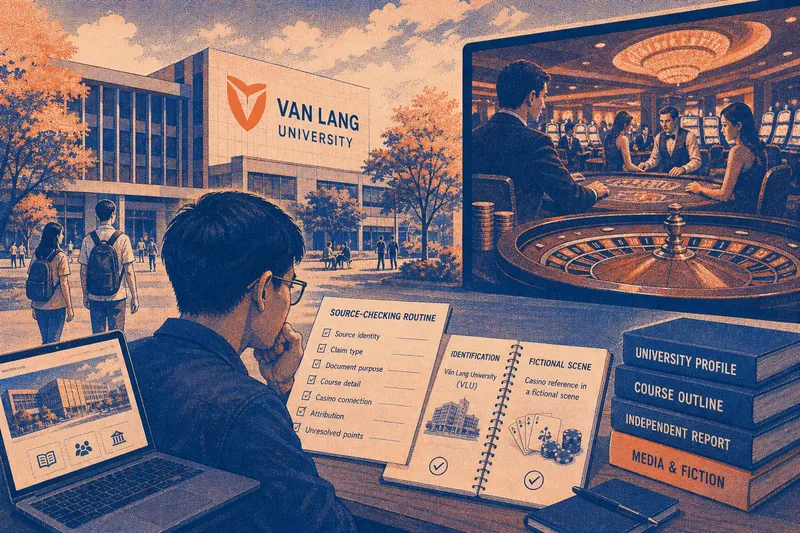
How Chance Became a Casino Story
Explore how casino stories turn chance into campus folklore, and learn to separate playful university identity from claims about real gambling culture.

How does chance become part of a university’s identity? A student society might put a roulette wheel on a poster for a fictional casino-themed event, turning the spin into shorthand for risk, luck and campus life. For a hypothetical discussion at Văn Lang University (VLU), the useful question is not whether the image describes actual gambling, but how a borrowed casino symbol acquires meaning in a university setting.
Casino culture can enter university life through film nights, event design, games and student-made stories. Each use carries a different implication: a wheel can suggest playful uncertainty, while a table and chips may evoke wealth or competition. Reading those choices carefully helps distinguish campus expression from claims about gambling itself.
Campus symbolism
A university is not only a place of formal learning; its identity is also made visible through shared images, activities and stories. Casino motifs can be used as a visual language for chance, spectacle or a night out, but their meaning depends on the setting and the people using them.
For a hypothetical VLU student group planning a themed cultural event, a deck of oversized cards might signal theatrical play rather than an invitation to gamble. The distinction becomes clearer when the event’s wording, activities and visual design are considered together, rather than treating one prop as proof of the organisers’ intentions.
Ask what the symbol is doing in its immediate campus context.
Learning through design
Casino-themed material can prompt learning about representation because students can examine how meaning is made. A poster’s colour, typography, wording and choice of objects all shape its tone; a lively design may foreground spectacle, while a restrained one may suggest a more reflective event.
In a hypothetical VLU seminar, students could compare a film still with a student-made event poster. They might identify what each image emphasises, then discuss how audience, purpose and setting alter the interpretation. This keeps the university connection central: the subject is not simply casino imagery on screen, but how a campus community might adopt, adapt or question it.
Use the design choices as evidence, and keep claims about intent tentative unless the creators explain them.
Reading campus imagery
Use these checks to decide what a casino reference may communicate in a university setting:
- Event wording: Check whether the text describes a performance, social gathering or gambling activity. If it names a theatrical or educational purpose, interpret the motif in that context; if the wording is unclear, ask the organisers before assigning an intent.
- Objects shown: Check whether the design uses cards, dice, chips or a wheel. If the objects appear as decorative props, discuss their symbolic role; if they are presented as functional game equipment, clarify what activity is planned.
- Audience: Check who the material appears to address, such as students, staff or the public. If it is tailored to a campus audience, consider how shared university references shape its meaning; if the audience is broad, avoid assuming a specifically student interpretation.
- Setting: Check whether the image is placed on a campus noticeboard, a course presentation or a public advertisement. If the setting is educational, connect the design to learning and discussion; if it promotes an event, assess it as communication for that event.
- Visual emphasis: Check what receives the largest or most prominent treatment. If the design foregrounds people and collaboration, analyse the social message; if it foregrounds money or winnings, ask whether that emphasis fits the stated purpose.
- Context supplied: Check whether a caption or event description explains the reference. If context is provided, use it to refine your interpretation; if it is absent, describe the ambiguity and seek clarification rather than treating a guess as fact.
Let the setting and purpose determine which interpretation deserves closer attention.
Identity and boundaries
Casino imagery can be playful without being culturally neutral. Its associations may include risk, glamour, luck or financial reward, and different viewers can respond to those associations in different ways. A university community can make room for those varied readings without implying that one symbol captures every student’s view.
There is also a boundary between using an image and endorsing everything it may evoke. A student-produced performance could use a roulette wheel to stage uncertainty, while a course discussion could question the glamour attached to casino scenes. Purpose, context and audience help clarify the difference.
When meaning is disputed, describe the visible choice before arguing about its implications.
Questions about campus casino culture?
Why might a university use casino imagery?
A campus group might use it to evoke chance, performance or a themed social event. The image alone does not establish whether gambling is involved, so the event description and activities matter.
How can students discuss casino motifs responsibly?
They can distinguish what an image shows from what they infer about its creators or audience. Tying each interpretation to wording, design or setting makes discussion more precise.
Does casino imagery represent VLU students?
No single poster, film or event can speak for a whole university community. A more careful account identifies the particular group, purpose and context rather than generalising from one example.
What makes a casino-themed event educational?
An educational purpose is clearer when the activity invites analysis, discussion or creative work and states that purpose plainly. The theme by itself does not show what participants will learn.
A worked campus scenario
Imagine an invented VLU student group preparing a fictional campus arts evening. Its starting materials are one poster draft with a roulette-wheel image, one event description that calls the evening a student film discussion, and one planned activity: comparing how films use symbols of chance. The group wants to know whether the design communicates the event’s purpose.
First, the group reads the description beside the poster. The description names film discussion, while the wheel suggests casino culture; the resulting decision is to keep the image only if the group is comfortable with that added association. Next, members review the planned activity: it concerns screen representation, not playing a game. They add that purpose to the poster, so viewers can see why the wheel appears.
Finally, they ask a student unfamiliar with the planning to describe the poster. If that reader identifies a film discussion, the design and wording are working together; if the reader expects a gambling event, the group revises the caption or replaces the wheel with a film-related image. The observable result is a clearer or still-ambiguous message, not proof of how every student will interpret it.
Meaning beyond campus
A campus reference can be read differently once it circulates beyond the event that produced it. A photograph of a themed poster, removed from its caption or venue, may appear to make a broader claim about university life than its creators intended.
That is why context belongs alongside interpretation. A reader can identify the image, explain its immediate purpose and note what remains unknown, without turning one campus artefact into a description of VLU as a whole.
Keep the event name or setting attached when sharing an image outside its original context.
Chance in university identity
Casino imagery can give a university activity a recognisable language for uncertainty, spectacle or play. At VLU, a hypothetical classroom or student-group discussion could use those symbols to examine how campus identity is designed, circulated and interpreted, while keeping the distinction between representation and real gambling clear.
For anyone searching how chance becomes a casino story in university culture, the most useful starting point is the local object: its wording, audience, setting and stated purpose. Those details make a reading more grounded, and they show where interpretation should stop until more context is available.